
Notice that I didn’t include ”a” before ”Liberal” in this headline. I’m not talking about USA liberal party. I’m talking about Liberalism as a more global concept.
I’ve debated myself a lot about this particular post, as I’m pretty sure it will generate some pretty bad hate coming my way. I’ve decided to publish it anyway, cuz I believe that what it talks about is what the political climate today really wants to silence. And I won’t stand for that.
It shouldn’t come as a surprise that I’m a pretty liberal guy.
Not in the polished, PR-approved sense, but in the old one. The kind that believes people are mostly decent when given the freedom to be. That progress grows from curiosity, not coercion. That conversation, real, uncomfortable, beautifully clumsy conversation, is the foundation of any society worth keeping.
That idea used to feel simple. Now it feels almost radical.
Because somewhere between the optimism of early internet culture and the dystopian chaos of today, liberalism was quietly rewritten by code.
How the system rewired us
The digital world didn’t just connect us; it trained us.
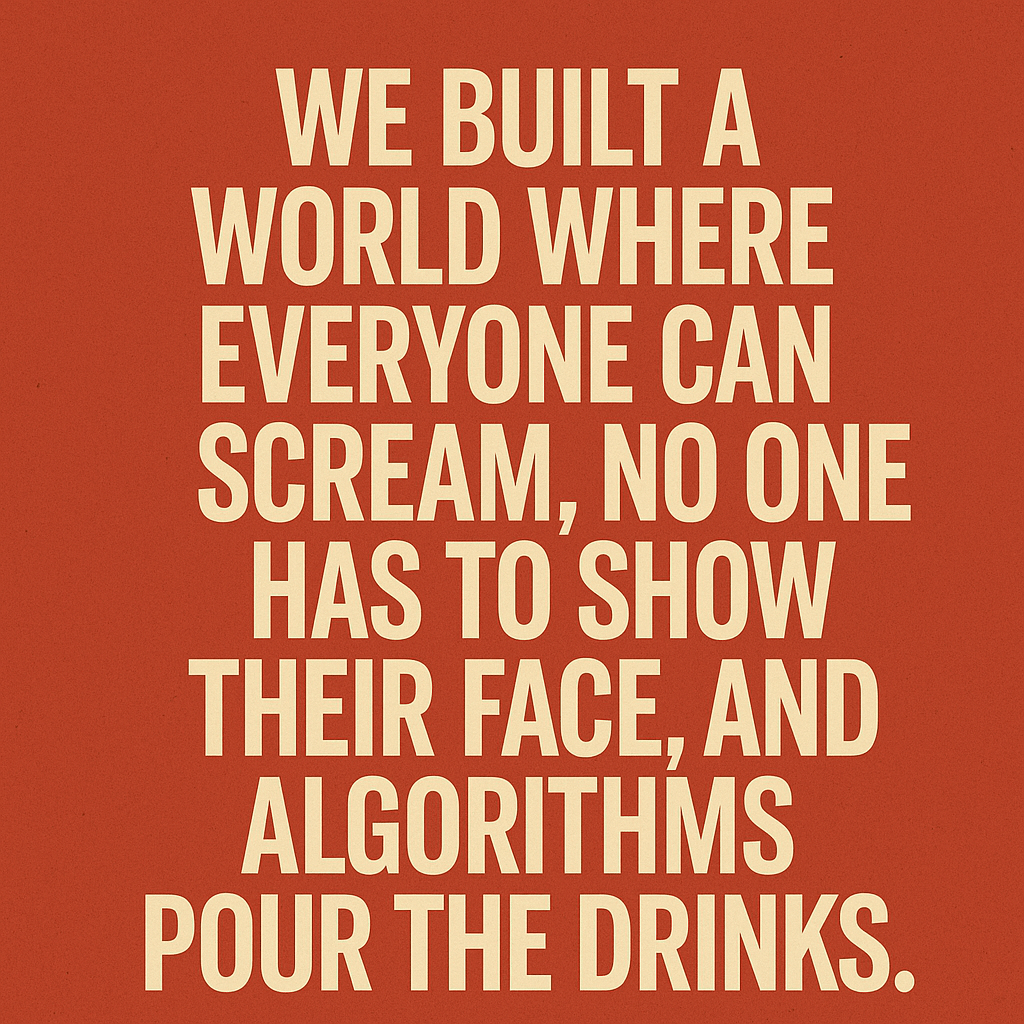
Algorithms turned attention into currency. Every click became data, every opinion content, every outrage engagement. The more emotional the reaction, the more valuable the post. And since rage spreads faster than reason, the networks learned to feed us rage, not because they hate us, but because it works.
It’s behavioral economics meets Pavlov. The platform rewards you for outrage, so you give it more. Your feed becomes a hall of mirrors reflecting only the extremes, and soon the idea of middle ground starts to look suspicious, even weak.
This is where liberalism – the global, human kind – starts to choke.
Because liberal thought depends on nuance. On slow thinking. On dialogue that isn’t profitable. But nuance doesn’t trend. Thoughtfulness doesn’t scale. And you can’t build a quarterly report out of quiet reflection.
So the algorithm did what capitalism always does: it optimized. It optimized for dopamine, not discourse.
And in doing so, it turned freedom of speech into a casino of noise and hate.
The mask and the megaphone
Then came anonymity. The digital cloak that once protected whistleblowers now shields anyone who wants to throw a punch without consequence. The trolls, the bots, the professional outrage artists, they all thrive because the system rewards aggression without requiring identity.
It’s the perfect paradox: the internet promised liberation of expression but delivered disconnection from responsibility. We created the largest experiment in human communication ever, and then stripped it of the one ingredient that makes communication human: accountability.
In that void, empathy evaporates.
When you can’t see the face of the person you’re speaking to, you stop caring if they flinch.
The result? A world where “freedom” has been gamified, empathy is throttled by engagement metrics, and truth is measured in likes.
The liberal dilemma
So what does it mean to be liberal now?
It means holding onto curiosity in a system that rewards certainty.
It means protecting speech without romanticizing cruelty.
It means knowing that every freedom needs a boundary that is not set by governments, but by conscience.
Being liberal today is an act of resistance against the machinery of reaction. It’s choosing to pause before posting, to listen before judging, to read something that doesn’t confirm what you already believe. It’s treating connection as sacred again.
We keep saying we want freedom, but what we’ve built is frictionless dependency. We scroll, we rage, we perform, all inside a feedback loop that calls itself community. The platforms didn’t kill liberalism. They hollowed it out and sold the echo.
The way back
But this isn’t a eulogy. Liberalism doesn’t die; it mutates. It survives every empire that tries to cage it because it lives in something algorithms can’t replicate: conscience.
The way back isn’t through censorship or control. It’s through re-humanizing the spaces we built.
That means designing systems that reward depth, not outrage. That means building digital architectures where disagreement isn’t punished by the mob, but nurtured into understanding. That means tech leaders willing to measure success not by “time on site” but by quality of thought exchanged.
And it means us – the users – reclaiming our agency. Turning off notifications. Refusing to feed the outrage machine. Choosing slow conversation over viral reaction.
Because being liberal, truly liberal, isn’t about ideology. It’s about believing in human potential enough to stop outsourcing our morality to code.
The wager
Liberalism has always been a gamble on humanity, in the belief that given freedom, we’ll choose creation over destruction. The internet was supposed to prove that right. Instead, it reminded us that technology amplifies whatever we are.
If we want a freer world, we have to become freer thinkers again.
If we want empathy, we have to log in as ourselves.
If we want truth, we have to reward honesty over performance.
The system isn’t broken. It’s obedient. It’s doing exactly what we trained it to do. The question is whether we’re brave enough to retrain ourselves.
Because the real battle for liberalism isn’t fought in parliament or press rooms. It’s fought in comment sections, in DMs, in every digital exchange where a human chooses curiosity over contempt.
That’s where the world shifts. Quietly. One mind at a time.
So yes, I’m a liberal. The messy kind. The stubborn kind. The kind that still believes in humans more than algorithms.
And I’m not giving that up.


 The Roine Playground
Lämna en kommentar