
There is something oddly reassuring about blaming generative AI for our current professional anxiety.
It lets us believe the problem arrived suddenly, from the outside. That we were competent until a machine disrupted us. That the solution is training, adaptation, and time. That this is just another wave to surf.
That story is wrong.
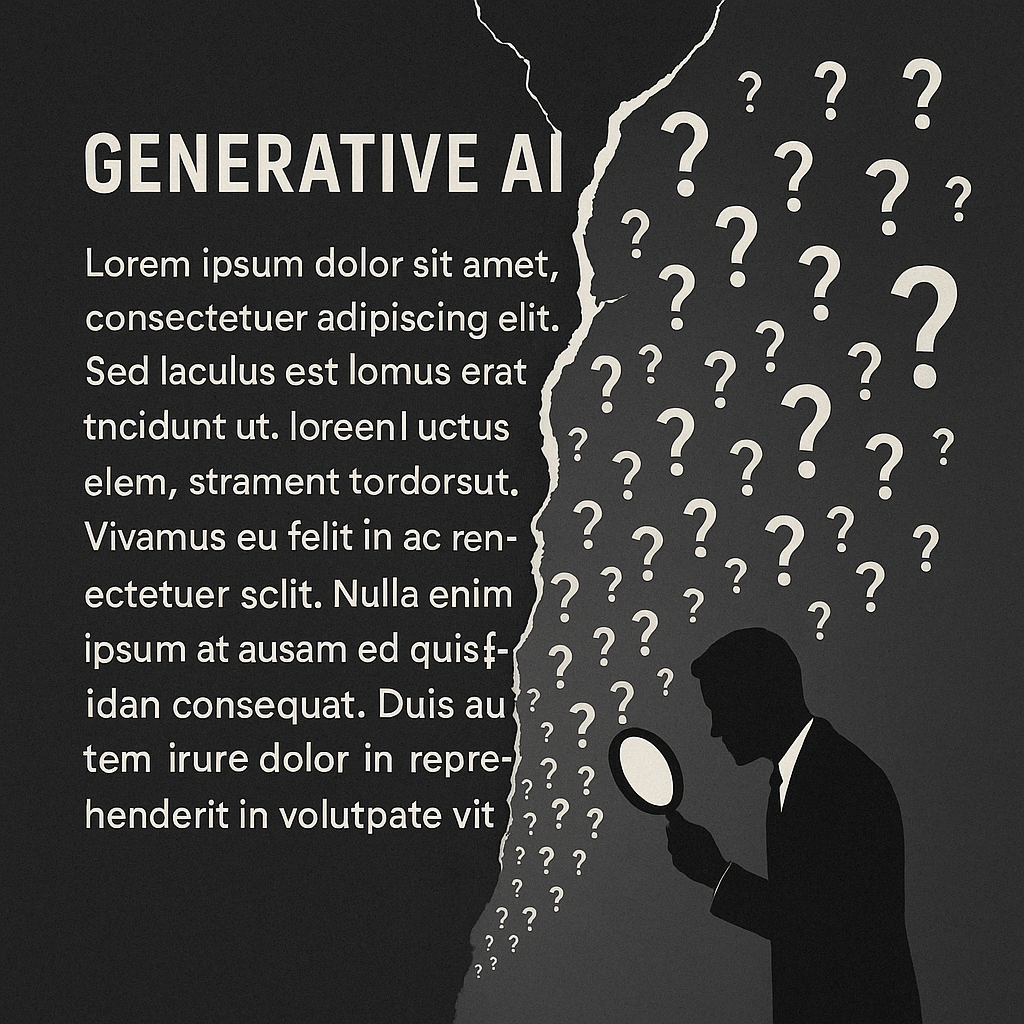
What generative AI has done is far more unsettling. It has removed the padding that allowed many professionals to operate without ever being truly tested. It has stripped away the rituals, delays, and collaborative fog that once hid weak thinking behind polished output.
This is not a disruption. It is an exposure.
And that is why it feels personal.
For a long time, modern knowledge work rewarded fluency above all else. If you could write smoothly, speak confidently, and deploy the right vocabulary, you were assumed to understand what you were doing. Entire careers were built on this assumption.
Reports did not need to be especially insightful as long as they looked complete. Strategies did not need to make hard choices as long as they referenced the right frameworks. Analysis did not need to be particularly sharp as long as it sounded serious.
Generative AI collapses that arrangement instantly.
It produces fluent language without effort. It mimics structure, tone, and professional cadence so well that these signals lose their value almost overnight. What once took days of drafting, alignment meetings, and revisions now appears in seconds.
And when fluency becomes free, the question shifts.
Not “can you produce this,” but “can you tell if this is any good.”
This is where the real skill gap begins.
One of the most common mistakes people make with generative AI is assuming the core challenge is prompting. That if only we phrase our requests more cleverly, the outputs will become reliable.
This belief is comforting because it suggests the solution is mechanical. Learn the syntax. Memorize patterns. Copy what others do.
But prompting is not the bottleneck. Thinking is.
Most weak AI outputs are not the result of poor phrasing. They are the result of vague intent. People ask for things they have not fully conceptualized themselves. They cannot articulate what success looks like, what constraints matter, or what tradeoffs they are willing to accept.
So the model fills in the gaps with generic logic and plausible assumptions. The result sounds professional and complete while quietly solving the wrong problem.
The AI did exactly what it was asked to do. It mirrored the user’s lack of clarity back to them, just more eloquently.
This is not a tooling issue. It is a cognitive one.
What makes this particularly dangerous is that generative AI is extremely good at producing text that feels finished.
It has conclusions. It has transitions. It has confident phrasing. It resolves its own arguments neatly.
I think humans are wired to trust that kind of coherence. We associate it with competence.
So people skim instead of interrogating. They accept instead of challenging. They forward instead of reviewing.
The ability to critically evaluate output has become the most important professional skill in an AI-assisted environment, and it is one that many people never had to develop properly.
Before AI, evaluation could be outsourced to process. Someone else would review. Another meeting would happen. Feedback cycles created the illusion of rigor even when no one was truly checking the substance.
Now the output arrives instantly, and the burden of judgment lands directly on the individual.
Many are discovering they do not know how to carry it.
Editing is where this gap becomes impossible to ignore.
Not cosmetic editing. Structural editing. The kind that asks what matters, what does not, and what should not exist at all.
Generative AI does not need a human to fix grammar. It needs a human to decide.
Decide what is true enough to keep.
Decide what is risky enough to remove.
Decide what is missing entirely.
Decide what must be rewritten from scratch.
This requires a deep understanding of the domain, the audience, and the consequences of being wrong. It requires the ability to step outside the text and see it as an object, not an extension of one’s own ego.
Many professionals never developed this skill because their value came from producing, not judging. AI flips that equation.
Those who cannot edit well either trust the output blindly or rewrite everything manually and declare AI useless. Both reactions point to the same absence.
They do not know how to evaluate work unless they authored it themselves.
There is a popular narrative that junior workers are the most vulnerable in this shift. That they will be displaced before they have a chance to learn.
This narrative is comforting because it suggests experience is a shield.
It is not.
The group under the most pressure right now is mid-level professionals whose expertise was built on repetition rather than understanding. People who learned which templates to apply, which phrases to use, which frameworks to cite, without ever being forced to explain why.
AI does those things effortlessly.
What it cannot do is reason about edge cases, explain failures, or adapt principles to new contexts. Those are human skills, but only if they were ever developed.
Experience without understanding turns out to be very fragile when output is no longer scarce.
Organizationally, this problem compounds.
Many companies are discovering that they do not actually know how work gets done. They have habits, not workflows. Informal norms, not clear stages of responsibility.
AI is dropped into this environment with vague encouragement to “use it where it helps.” No one defines where it should sit, what must happen before its use, or what must happen after.
So drafts flow directly into production. Reviews become optional. Accountability becomes blurry. Quality becomes inconsistent.
Leadership reacts by oscillating between fear and hype. Ban it here. Mandate it there.
Neither response addresses the underlying issue.
AI did not break the workflow. It revealed that the workflow was never designed for judgment at scale.
Ethics enters the conversation here, usually in the least useful way possible.
Abstract principles. High-level values. Compliance decks that reassure legal teams while leaving workers just as confused as before.
Most AI-related harm does not come from bad actors. It comes from people who do not understand where the risks are.
They do not know when data exposure becomes dangerous. They do not know when an AI-generated text crosses into legal liability. They do not recognize subtle bias because it does not look malicious.
These are not philosophical problems. They are practical ones.
And they require concrete literacy, not moral slogans.
Perhaps the most sensitive exposure is happening at the leadership level.
Many managers are quietly struggling to evaluate AI-assisted work. They cannot tell whether something is genuinely good or merely fast. They cannot distinguish thoughtful output from plausible filler. They cannot see where human judgment was applied and where it was skipped.
This creates insecurity.
Some leaders respond by banning AI to reassert control. Others mandate its use to signal modernity.
Both approaches avoid the harder task of developing the judgment required to lead in an AI-augmented environment.
If you cannot evaluate the work, you cannot meaningfully direct it. And no tool fixes that.
All of this explains why the current moment feels so uncomfortable.
Generative AI removes the soft barriers that once protected people from scrutiny. It compresses time. It exposes thinking. It makes weak reasoning visible faster than organizations are used to confronting it.
It does not care about seniority. It does not respect confidence. It does not reward effort for its own sake.
It simply raises the question that many roles have been able to avoid for years.
What value do you add when output is cheap?
The answer is not generation. It is judgment.
Generative AI did not lower the bar.
It raised it.
It made clarity mandatory.
It made responsibility unavoidable.
It made thinking visible.
This is not an AI revolution in the sense people like to imagine. It is not about tools replacing humans.
It is about humans being forced to confront the quality of their own thinking.
And that is why the conversation feels so charged.
Because for the first time in a long time, sounding smart is no longer enough.


 The Roine Playground
Lämna en kommentar